
Java Full Stack Developer Roadmap 2026: Step-by-Step Guide for Freshers
By Elearn Infotech Career Guidance Team, with input from our Java Full Stack trainer · Updated
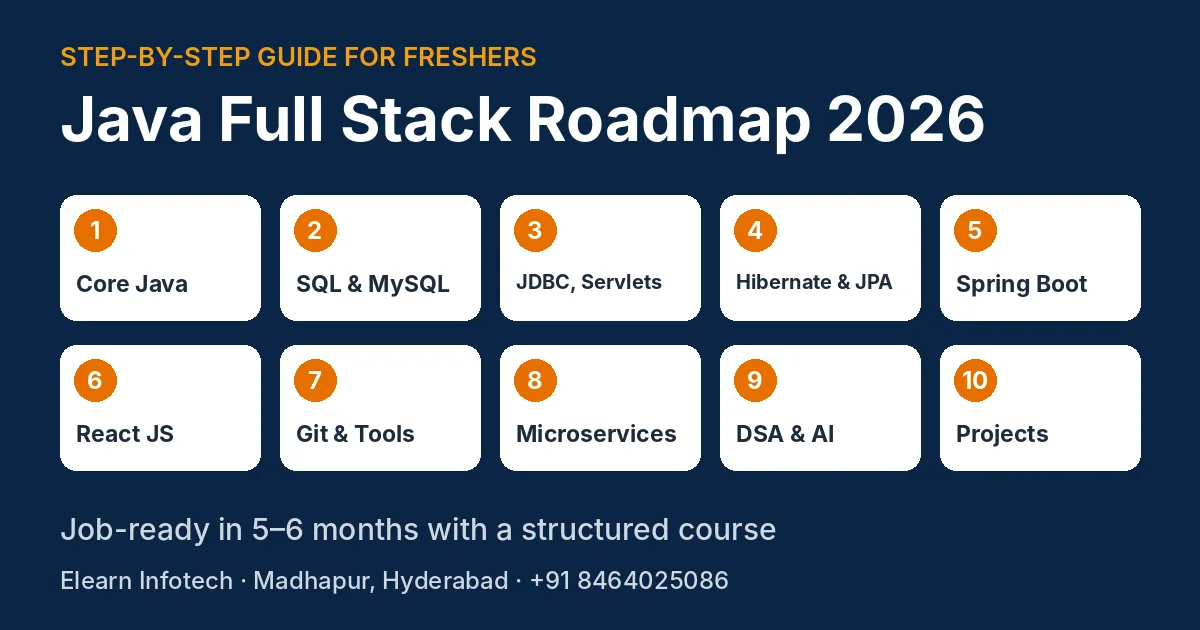
Quick answer: To become a Java Full Stack Developer in 2026, learn in this order: Core Java, SQL and MySQL, JDBC, Servlets and JSP, Hibernate and JPA, Spring and Spring Boot with REST APIs, then the front end with HTML, CSS, JavaScript and React JS. Add Git, microservices, Docker and DSA, build 5–6 real projects and practise interviews. With a structured course, most freshers become job-ready in 5–6 months.
Java Full Stack is one of the most popular career paths for freshers in Hyderabad, especially for those who want to join large IT companies. But the list of topics is long, and many students get lost between Core Java, Spring, React and microservices. This Java full stack roadmap shows what to learn, in which order and how long each step takes, in simple words.
"Master Java with strong programming fundamentals and develop the skills to build robust, scalable applications."
– Mr. MSN Raju, Full Stack Java Developer (15+ years, top MNCs), Java Full Stack trainer at Elearn Infotech
The Roadmap at a Glance
| Step | What to learn | Why it matters | Time (with a course) |
|---|---|---|---|
| 1 | Core Java | The base for everything else in the stack | 5–6 weeks |
| 2 | SQL and MySQL | Every application stores data | 2 weeks |
| 3 | JDBC, Servlets and JSP | Shows how Java web apps work underneath | 2–3 weeks |
| 4 | Hibernate and JPA | Work with databases using Java objects | 2 weeks |
| 5 | Spring and Spring Boot | The main back-end framework companies use | 4–5 weeks |
| 6 | Front end: HTML, CSS, JavaScript, React JS | Build the screens users see | 4 weeks |
| 7 | Tools: Git, Maven, Postman, Swagger | Used daily in real projects | Along the way |
| 8 | Microservices, Kafka, Docker, AWS basics | Skills large companies ask for | 2–3 weeks |
| 9 | DSA and AI tools | Clear coding rounds and work faster | Throughout |
| 10 | Projects, resume and interviews | Turn skills into a job offer | Throughout and last 2 weeks |
Step 1: Core Java
Everything in Java Full Stack sits on Core Java, so don't rush this step. Freshers who skip ahead to Spring Boot without strong basics usually struggle in interviews.
Learn: variables, loops and conditions, OOP (classes, objects, inheritance, polymorphism, abstraction, encapsulation), strings, exception handling, collections (List, Set, Map), multithreading basics and Java 8 features such as lambdas and streams.
Practice idea: build a small console app, such as a library or student management system, using classes and collections.
Step 2: SQL and MySQL
Almost every application stores data in a database. You need to create tables and write queries confidently.
Learn: creating tables, SELECT, WHERE, JOINs, GROUP BY, keys and basic normalisation.
Step 3: JDBC, Servlets and JSP
These older technologies are still worth learning because they show what frameworks like Spring do behind the scenes. Interviewers often ask about them too.
Learn: connecting Java to MySQL with JDBC, handling web requests with Servlets, and creating simple pages with JSP.
Step 4: Hibernate and JPA
Hibernate lets you save and read data using Java objects instead of writing SQL for every action. It saves time and reduces mistakes.
Learn: entity classes, mappings (one-to-many, many-to-many) and basic queries with JPA.
Step 5: Spring and Spring Boot
This is the heart of Java back-end development today. Spring Boot is one of the most requested skills in Java developer job descriptions.
Learn: dependency injection, Spring Boot setup, building REST APIs, Spring Data JPA, validation, exception handling and Spring Security basics.
Practice idea: build a REST API for an employee or product system with create, read, update and delete (CRUD), and test it in Postman.
Step 6: Front End with HTML, CSS, JavaScript and React JS
A full stack developer builds both sides. Start with HTML and CSS, add Bootstrap for quick layouts, learn JavaScript well, then move to React JS.
Learn: page layout, responsive design, JavaScript basics and ES6, React components, state, hooks and calling your Spring Boot APIs from React.
Step 7: Tools You Use Every Day
- Git and GitHub: save and share your code, and show your projects to recruiters.
- Maven: manage project libraries and builds.
- Postman: test your APIs.
- Swagger: document your APIs so others can use them.
Step 8: Microservices, Kafka, Docker and AWS Basics
Large companies split big applications into smaller services that talk to each other. Knowing the basics gives you an edge in interviews.
Learn: microservices with Spring Cloud and Eureka, messaging with Kafka, packaging apps with Docker, and deploying on AWS at a basic level.
Step 9: DSA and AI Tools
Many companies start with a coding round, so practise Data Structures and Algorithms (arrays, strings, linked lists, stacks, queues, sorting and searching) in Java a little every day. Also learn to use AI tools to explain errors and draft code faster, but always understand and test what they give you.
Step 10: Projects, Resume and Interviews
Projects are your proof. Aim for 5–6 complete projects that use Spring Boot, a database and a React front end.
Project ideas:
- Employee management system (Spring Boot + React + MySQL)
- E-commerce product and cart app
- Online banking or wallet app with Spring Security
- Hospital or appointment booking system
- A small microservices project with two or three services
Put your GitHub link and projects at the top of your resume. Practise explaining each project: what it does, how you built it and what you would improve.
Real Student Story
Saketh Kumar studied B.Com, not computer science. He joined our Java Full Stack course and is now working as a Full Stack Developer. His story shows that a commerce degree does not stop you from becoming a developer.
5 Mistakes to Avoid
- Rushing Core Java. Weak basics show up in every interview.
- Learning Spring Boot only from videos. Build APIs yourself and test them.
- Ignoring the front end. Full stack roles expect at least basic React.
- Skipping DSA. Many companies filter candidates with a coding test.
- No projects on GitHub. Recruiters want to see your code.
How Long Does the Java Full Stack Roadmap Take?
With a structured course and 3–4 hours of daily practice, most freshers become job-ready in 5–6 months. Learning on your own usually takes longer, because it is easy to get stuck or study topics in the wrong order. Students who already know some Java from college often move faster.
Java Full Stack Course in Hyderabad at Elearn Infotech

If you want to follow this roadmap with a trainer, our Java Full Stack Developer course in Hyderabad covers every step above, from Core Java to Spring Boot, React JS, microservices, Kafka, Docker, AWS basics, DSA and Gen AI tools.
- Duration and fee: 5–6 months, ₹30,000
- Projects: 6 real-time projects
- Trainer: Mr. MSN Raju, Full Stack Java Developer with 15+ years of experience at top MNCs
- Mode: Java Full Stack training in Hyderabad at our Madhapur institute, near Hitech City, or live online
- Placement: placement assistance, including resume preparation, mock interviews and referrals
Looking for a Java Full Stack institute in Hyderabad near you? Students join our Madhapur classes from Gachibowli, Kondapur, Kukatpally, KPHB, Ameerpet and Secunderabad. Still comparing stacks? Read Python Full Stack vs Java Full Stack vs MERN.
Frequently Asked Questions
How do I become a Java Full Stack Developer in 2026?
Learn Core Java, SQL and MySQL, JDBC, Servlets and JSP, Hibernate and JPA, Spring and Spring Boot with REST APIs, and the front end with HTML, CSS, JavaScript and React JS. Add Git, microservices, Docker and DSA, build 5–6 projects and practise interviews.
How long does it take to become a Java Full Stack Developer?
With a structured course and daily practice, most freshers become job-ready in 5–6 months. Learning on your own usually takes longer. Students who already know some Java from college often move faster.
Is Java Full Stack good for freshers in 2026?
Yes. Java Full Stack developers are hired by large IT services companies, banks and enterprise software companies. Freshers with strong Core Java, Spring Boot, React and a few complete projects can apply for Java Developer and Full Stack Developer roles.
Can a non-IT student learn Java Full Stack?
Yes, but expect the first few weeks of Core Java to need extra practice. With daily coding and a trainer to clear doubts, non-IT graduates can learn Java Full Stack step by step. For example, our student Saketh Kumar, a B.Com graduate, is now working as a Full Stack Developer.
Should I learn Spring Boot or React first?
Learn Core Java, SQL and Spring Boot first, then React. The back end is the main focus of most Java Full Stack roles, and once your APIs work, connecting a React front end is easier.
Do I need DSA for Java Full Stack jobs?
Yes. Many companies start with a coding test, so practise Data Structures and Algorithms in Java regularly alongside the main course.
What projects should a Java Full Stack fresher build?
Good projects include an employee management system, an e-commerce app, a banking or wallet app with Spring Security, an appointment booking system and a small microservices project, each using Spring Boot, a database and React.
What is the Java Full Stack course fee in Hyderabad at Elearn Infotech?
The Java Full Stack Developer course at Elearn Infotech, Madhapur is ₹30,000 for 5–6 months, with 6 real-time projects and placement assistance, in classroom and live online modes. It is taught by Mr. MSN Raju, a Full Stack Java Developer with 15+ years of experience at top MNCs.
Related: Python Full Stack vs Java Full Stack vs MERN · Full Stack Developer Career Opportunities in India (2026)
Note & About this Guide
This guide was written by the Elearn Infotech career guidance team in Madhapur, Hyderabad, based on how our Java Full Stack trainer teaches freshers and the questions students ask us at counselling. Course fees, durations and project counts are correct as of November 2026; please call us for the latest batch details.