
Python Full Stack vs Java Full Stack vs MERN: Which Should You Choose in 2026?
By Elearn Infotech Career Guidance Team, with input from our full stack trainers · Updated
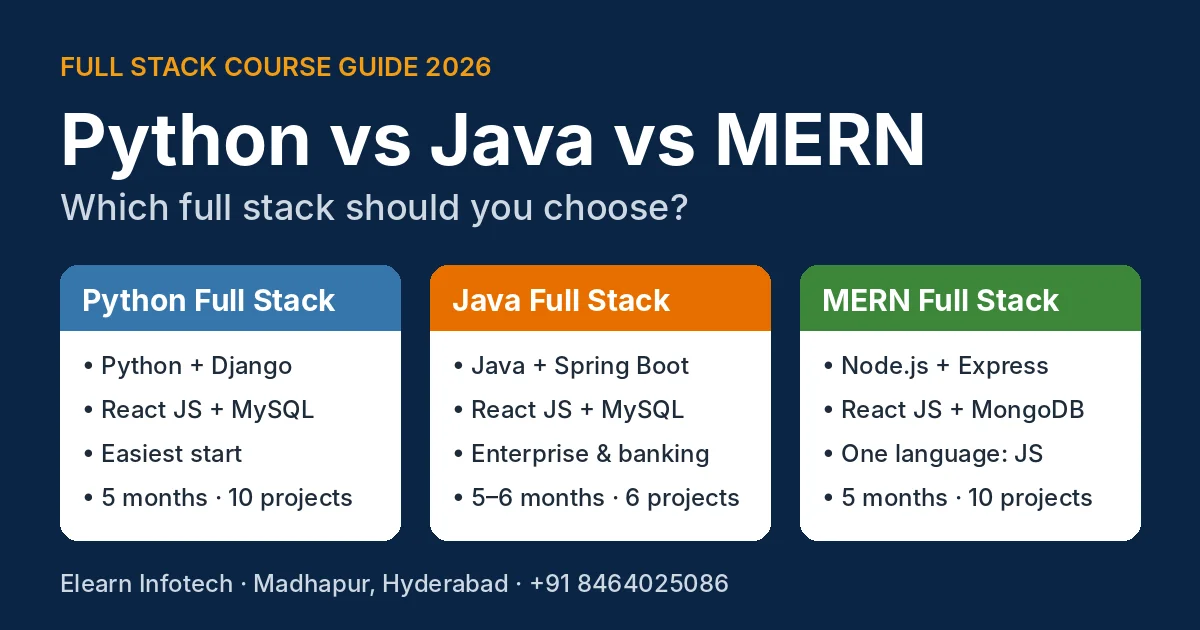
Quick answer: All three lead to full stack developer jobs. The main difference is the back-end language. Choose Python Full Stack if you are a beginner or may move into data and AI later. Choose Java Full Stack if you want to work on large enterprise and banking projects. Choose MERN Full Stack if you want to use one language, JavaScript, for both the front end and the back end. All three use React JS for the front end.
"Python, Java or MERN?" is one of the most common questions freshers ask us before joining a full stack course. Friends give different advice, and every YouTube video seems to say something else. This guide compares the three in simple words, so you can choose based on your goals, not on what others say.
What All Three Have in Common
Before looking at the differences, it helps to know what stays the same. In all three courses you learn:
- Front end: HTML, CSS, JavaScript and React JS, to build what users see.
- Back end: a programming language and framework, to write the business logic.
- Database: how to store and fetch data.
- REST APIs: how the front end and back end talk to each other.
- Real projects: complete applications you can show in interviews.
So whichever stack you pick, about half of what you learn is the same. If you change your mind later, switching is easier than most freshers think.
Side-by-Side Comparison
The fees, durations and project counts below are for Elearn Infotech, Madhapur, and are the same for classroom and live online training.
| Python Full Stack | Java Full Stack | MERN Full Stack | |
|---|---|---|---|
| Back-end language | Python | Java | JavaScript (Node.js) |
| Main framework | Django | Spring Boot | Express JS |
| Front end | React JS | React JS | React JS |
| Database | MySQL | MySQL | MongoDB |
| Ease for beginners | Easiest | Hardest at the start | Medium |
| Extra topics | DSA, Gen AI | Microservices, Kafka, Docker, AWS basics, DSA, Gen AI | Bootstrap, jQuery, REST API projects |
| Duration | 5 months | 5–6 months | 5 months |
| Fee | ₹25,000 | ₹30,000 | ₹25,000 |
| Real-time projects | 10 | 6 | 10 |
| Trainer | Mr. Sudheer M, Python Full Stack Developer, 12+ years | Mr. Raju, Full Stack Java Developer, 15+ years | Mr. Chandra Sekhar, Full Stack Developer, 13+ years |
| Often used in | Startups, product companies, data and AI teams | Large IT services companies, banking and enterprise projects | Startups, product companies, web agencies |
All three trainers have worked for MNCs. All three courses include placement assistance: resume preparation, mock interviews and referrals.
Python Full Stack: Easiest Start, Most Flexible
Python reads almost like plain English, so it is the easiest of the three to learn. With Django, you can build a working web application quickly, because many features, such as login and an admin panel, come built in.
Choose Python Full Stack if:
- You are new to coding or from a non-IT background.
- You may want to move into Data Analytics, Data Science or AI later. Python is the main language in those fields too.
- You like writing less code to get results.
Keep in mind: because Python is popular with freshers, you will compete with many applicants. Strong projects and DSA practice help you stand out.
"Learn Python with practical insights and build the foundation to turn your ideas into powerful real-world applications."
– Mr. Sudheer M, Python Full Stack Developer (12+ years, MNCs), Python Full Stack trainer at Elearn Infotech
Student story: Girish. Girish chose our Python Full Stack Development course and got a job after completing it.
See the full syllabus: Python Full Stack Developer Course in Hyderabad.
Java Full Stack: Built for Large Companies
Java is stricter than Python. You write more code, and the rules are tighter. That feels harder at first, but it is exactly why large companies and banks trust Java for big systems that run for years. Spring Boot and microservices are skills these companies ask for in interviews.
Choose Java Full Stack if:
- You want to join a large IT services company or work on banking and enterprise projects.
- You studied Java in college and want to build on it.
- You are ready for a slightly longer, more demanding course.
Keep in mind: the first month needs patience, because Java has more concepts to learn before you build web applications.
"Master Java with strong programming fundamentals and develop the skills to build robust, scalable applications."
– Mr. Raju, Full Stack Java Developer (15+ years, top MNCs), Java Full Stack trainer at Elearn Infotech
See the full syllabus: Java Full Stack Developer Course in Hyderabad.
MERN Full Stack: One Language for Everything
MERN stands for MongoDB, Express JS, React JS and Node.js. Everything is JavaScript, so you learn one language and use it on both the front end and the back end. That saves time and makes it easier to understand how a whole application works.
Choose MERN Full Stack if:
- You enjoy building websites and want to see results on screen quickly.
- You want to work in startups or product companies that build modern web apps.
- You like the idea of mastering one language deeply.
Keep in mind: MongoDB stores data differently from MySQL. It is worth also learning basic SQL, because many companies use both.
"Explore the power of the MERN Stack and transform your creativity into dynamic, full-stack web applications."
– Mr. Chandra Sekhar, Full Stack Developer (13+ years, multiple MNCs), MERN Stack trainer at Elearn Infotech
Our MERN course includes 10 named projects. They range from a Corporate Company website and a Hospital & Healthcare site to a Job Portal and a CRM built with the full MERN stack. See them on the MERN Full Stack Developer Course page.
Which One Has More Jobs?
All three have steady demand in Hyderabad and across India. The difference is where the jobs are:
- Java: large IT services companies, banks, insurance and enterprise software.
- Python: startups and product companies, plus roles that mix web development with data or AI.
- MERN: startups, product companies and digital agencies building modern web apps.
In interviews, companies care more about what you can build than which stack you chose. A fresher with 6–10 solid projects and clear basics usually does better than one who only knows the theory of a "popular" stack.
Which Is Best for Non-IT Freshers?
For most non-IT freshers, Python Full Stack is the easiest start, because Python is simple to read and write. MERN is a good second choice if you enjoy design and seeing your work in the browser. Java Full Stack is very doable too, but expect the first few weeks to feel slower.
Not sure you want back-end work at all? Our 3-month UI Development course focuses on the front end, from HTML and CSS to React JS.
Quick Decision Guide
| If this sounds like you… | Choose |
|---|---|
| "I'm new to coding and want the easiest start." | Python Full Stack |
| "I may want to work in data or AI later." | Python Full Stack |
| "I want to work for a large IT company or bank." | Java Full Stack |
| "I learned Java in college." | Java Full Stack |
| "I want to learn one language for everything." | MERN Full Stack |
| "I like building websites and seeing results fast." | MERN Full Stack |
Still Confused? Try This
- Write down which kind of company you would like to work for: startup, product company or large IT company.
- Attend a free demo class for two of the three stacks.
- Ask each trainer which projects you will build and how they help in interviews.
- Choose the one you felt most curious about after the demo.
Where Elearn Infotech Fits
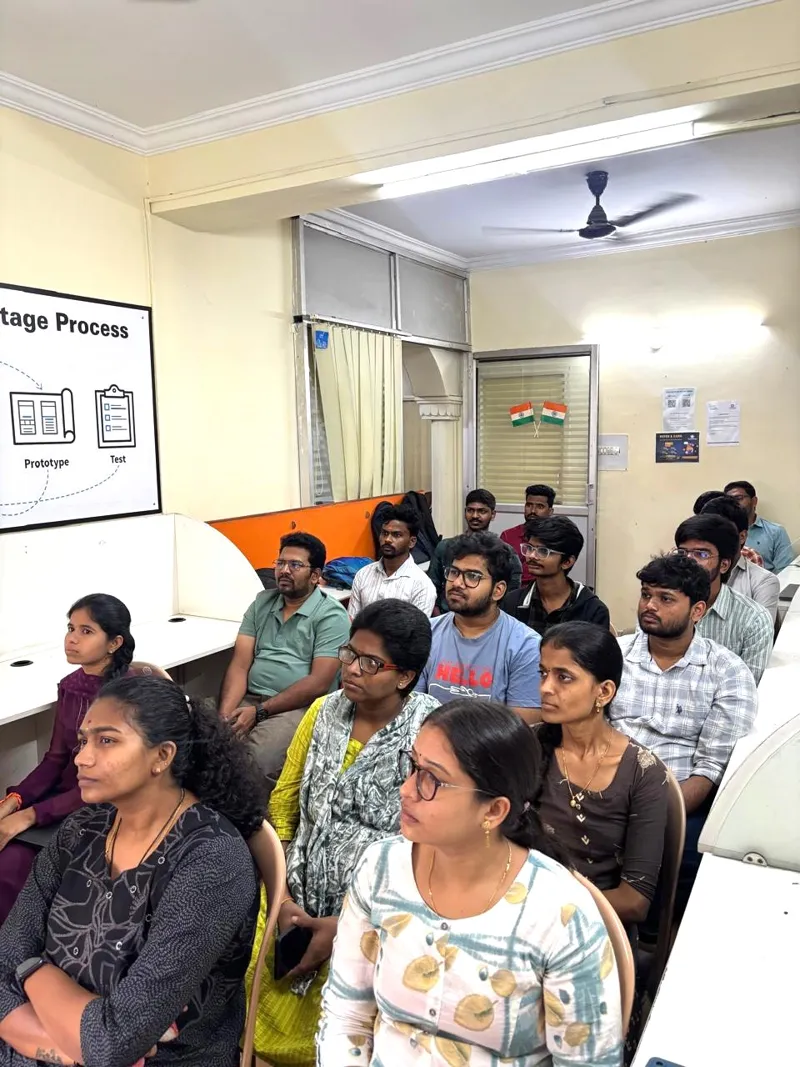
Elearn Infotech in Madhapur, near Hitech City, teaches all three full stack courses in classroom and live online modes. Each is taught by a trainer who has worked for MNCs, includes real-time projects and comes with placement assistance. Students join from Gachibowli, Kondapur, Kukatpally, KPHB, Ameerpet and Secunderabad.
Need help choosing? Call or WhatsApp +91 8464025086 for free counselling, or book a free demo class.
Frequently Asked Questions
Which is better: Python Full Stack, Java Full Stack or MERN?
None is better for everyone. Python Full Stack is the easiest to start and links to data and AI careers. Java Full Stack suits large IT companies and banking projects. MERN uses JavaScript for both front end and back end and suits startups and product companies. Choose based on your goals and the kind of company you want to join.
Which full stack is easiest for beginners?
Python Full Stack is usually the easiest for beginners because Python is simple to read and write, and Django gives you many features built in. MERN is a good second choice. Java Full Stack takes more patience in the first few weeks.
Which full stack is best for non-IT freshers?
Most non-IT freshers find Python Full Stack the easiest start. MERN also works well if you enjoy building websites. Java Full Stack is possible too, but the first month needs more practice.
Which full stack has more jobs in Hyderabad?
All three have steady demand. Java jobs are common in large IT services companies and banks. Python jobs are common in startups, product companies and data or AI teams. MERN jobs are common in startups, product companies and digital agencies. Your projects and basics matter more than the stack you choose.
Do all three full stack courses teach React JS?
Yes. Python Full Stack, Java Full Stack and MERN Full Stack all use React JS for the front end, along with HTML, CSS and JavaScript.
What is the fee and duration of each full stack course at Elearn Infotech?
Python Full Stack is ₹25,000 for 5 months with 10 projects. Java Full Stack is ₹30,000 for 5–6 months with 6 projects. MERN Full Stack is ₹25,000 for 5 months with 10 projects. Fees are the same for classroom and online training.
Can I switch from one stack to another later?
Yes. About half of what you learn is the same in all three: HTML, CSS, JavaScript, React JS, REST APIs and database basics. Once you know one stack well, learning another back-end language is much faster.
Do these full stack courses include placement support?
Yes. All three courses at Elearn Infotech include placement assistance: resume preparation, mock interviews and referrals to hiring companies.
Related: Which Software Course Should a Fresher Choose in 2026? · Full Stack Developer Career Opportunities in India (2026)
Note & About this Guide
This guide was written by the Elearn Infotech career guidance team in Madhapur, Hyderabad, based on the questions freshers ask us before choosing a full stack course, with input from our trainers Mr. Sudheer M, Mr. Raju and Mr. Chandra Sekhar. Course fees, durations and project counts are correct as of October 2026; please call us for the latest batch details.